History
Bisket Jatra is the New Year festival of Bhaktapur, one of the three ancient kingdoms of the Kathmandu Valley. The name is believed to derive from "Bi" (snake) and "syaku" (killed) — referencing a legend in which two serpents were slain by a hero to free a cursed princess.
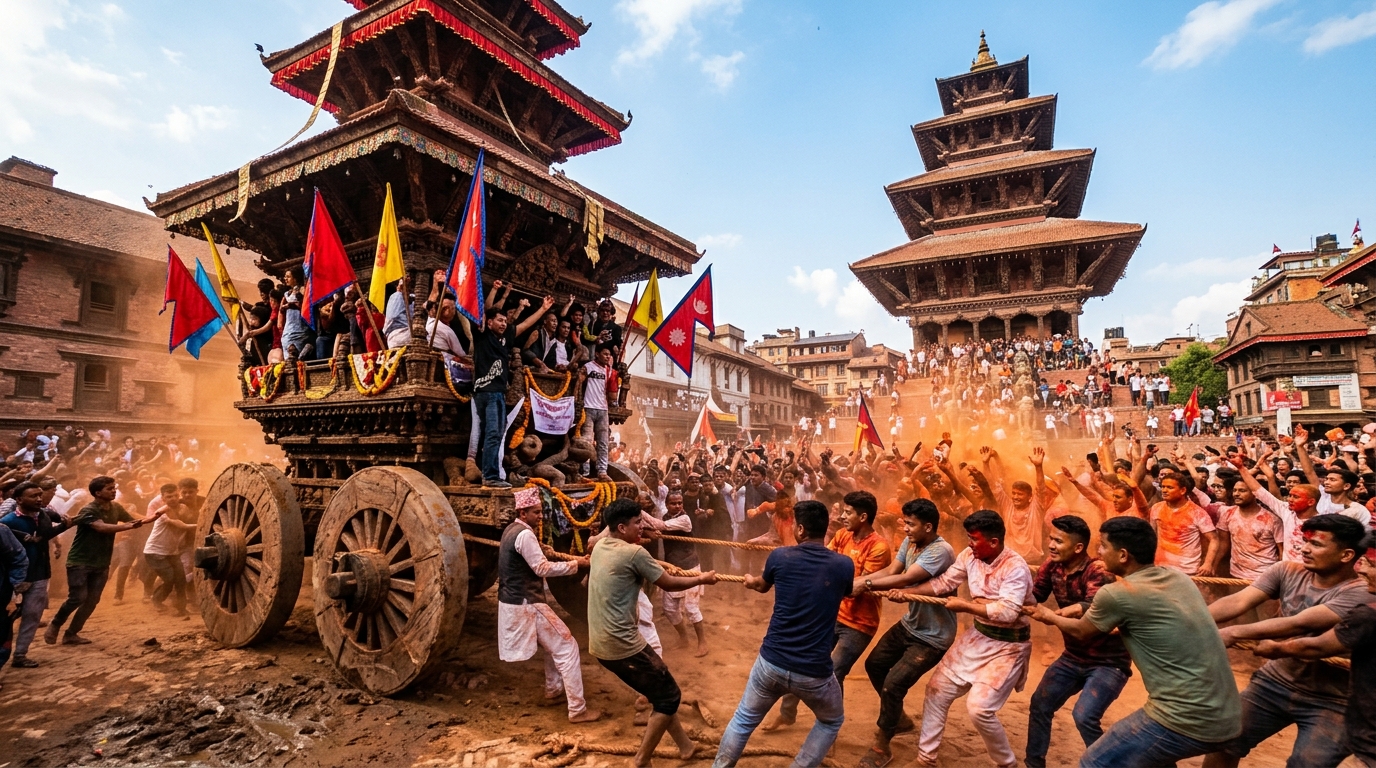
The festival, observed on the day of Nepali New Year (Baisakh 1, mid-April), centres on a giant wooden chariot of Bhairav (a fierce manifestation of Shiva) that is pulled through the streets of Bhaktapur. The city is literally divided — residents of the upper town pull the chariot one way, the lower town the other — in an epic tug-of-war that determines auspicious omens for the year ahead.
Significance
The culmination of Bisket Jatra is the erection of the Lingo — a massive bamboo pole planted at Khalna Tole. The pole, which can be over 25 metres tall, is hung with two long snake-shaped banners. Its raising signals the New Year, and its controlled lowering on the last day marks the end of the festival. The noise, energy, and communal effort involved in both raising and lowering the Lingo make it one of the most visceral festival experiences in Nepal.
What to Expect
Bisket Jatra runs for several days around Nepali New Year (April 13–14 by the Gregorian calendar). The chariot pulling at Taumadhi Tole is the main draw — arrive early for a position near the front. The Lingo erection at Khalna Tole happens on the first day of the New Year; the atmosphere is part carnival, part sacred ceremony. Bhaktapur's Durbar Square (a UNESCO World Heritage Site) provides a stunning backdrop. Stay for the evening when the old city is lit by torches.