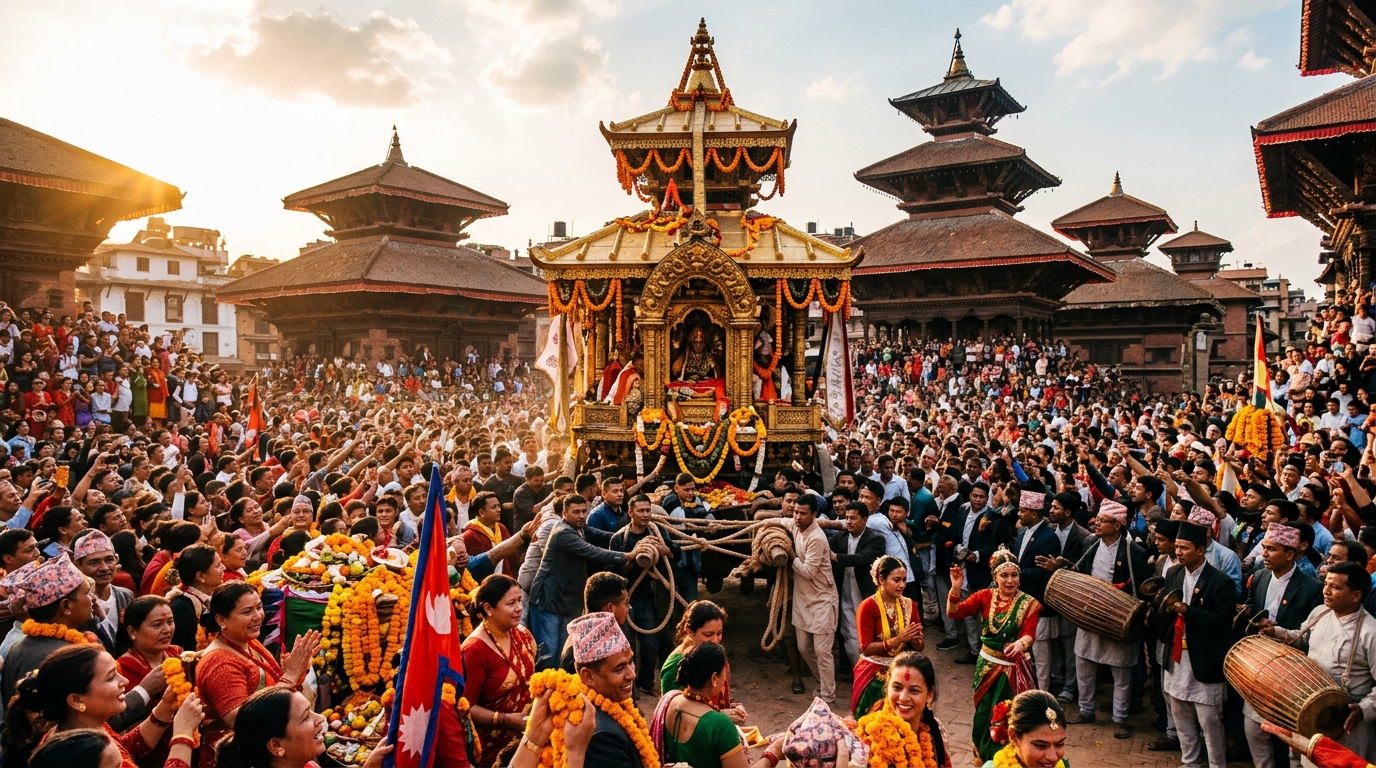
The Mythological Origin of Yenya
Indra Jatra (known classically as Yenya, meaning "Kathmandu Festival" in the Newar language) is the largest and most exhilarating socio-religious street festival in Nepal. Celebrated for eight full days during the lunar month of Bhadra / Ashwin (September–October), the festival weaves together ancient agrarian rites, royal patronage, and Tantric mysticism.
According to ancient lore, Lord Indra, the Vedic king of the heavens and ruler of rain, descended disguised as a mortal to the Kathmandu Valley to pluck night-blooming white jasmine (Parijat) flowers for his mother, Goddess Dangi (Dakini), who needed them to perform a sacred ritual (Vrata). The vigilant valley farmers caught the deity trespassing, accused him of flower theft, and bound his arms and legs in public view at Maru Tole.
Realizing her son was missing, Goddess Dangi descended to the Kathmandu Valley. Overwhelmed by remorse upon discovering the captive's true identity, the people of Kathmandu agreed to release Indra on two conditions:
- That Indra would bestow morning dew and timely monsoon rains upon the valley's paddy crops until the harvest.
- That Goddess Dangi would lead the souls of all citizens who had died in the past year into heaven (Swarga).
To this day, the eight days of Indra Jatra commemorate this divine covenant through processions, dances, and memorial offerings.
The Complete 8-Day Sacred Program Schedule
Indra Jatra is celebrated through an intricate, non-stop eight-day sequence where each day carries dedicated rituals and historic routes:
Day 1: Yasin Thanegu (Erection of the Linga Pole)
The festival officially opens at Hanuman Dhoka Durbar Square when a monumental, straight pine timber known as the Yasin (or Indra Dhoj) is raised. Selected months in advance from the sacred forests of Nala or Sallaghari, the pole is hauled by guthi members and hoisted upright by hundreds of men using thick hemp ropes and wooden props, accompanied by a traditional gunfire salute and the blare of ceremonial trumpets (Kahabaja and Dhime). The raising of the flag signifies Indra’s victory over demonic forces.
Day 2: Kwaneya (The Southern Chariot Route — Main Kumari Jatra)
Known as Yenya Punhi (the full moon day), this is the most auspicious day of the festival. Three massive gilded wooden chariots carrying the Living Goddess Kumari, the child god Ganesh, and the wrathful god Bhairav are drawn through the historic southern quarter of Kathmandu:
- Route: Basantapur → Maru → Chikanmugal → Jaisidewal → Jyabahal → Lagan → Brahma Tole → Wonde → Kohity → Basantapur. The Head of State (President of Nepal) and dignitaries gather at the ancient Gaddi Baithak palace balcony to pay homage and receive sacred tika and flower prasad directly from the Living Goddess.
Day 3: Yeneya (The Northern Chariot Route)
On the second chariot procession day, the divine entourage is pulled through the crowded northern merchant quarters:
- Route: Basantapur → Pyaphal → Yatkha → Nyokha → Tengal → Bangemuda → Bhedasingh → Kilagal → Indra Chowk → Makhan → Basantapur. Streets are packed shoulder-to-shoulder with devotees showering marigold petals, dry puffed rice, and coin offerings from traditional carved wooden windows (Jhyal).
Day 4: Dangi Procession & Bau Mata (The Ancestral Light)
Following the northern chariot return, a woman adorned in traditional yellow regalia representing Goddess Dangi marches barefoot through the old town's perimeter, leading families who have lost relatives over the preceding year. Behind Dangi follows Bau Mata — an awe-inspiring 15-meter illuminated reed serpent effigy lit with rows of flickering oil lamps that symbolically guides souls through the dark passage to heaven.
Day 5: Sacred Mask Street Dances (Majipa Lakhey & Pulukisi)
The peak day of theatrical street devotion:
- Majipa Lakhey: The wrathful demon turned compassionate protector of Kathmandu, wearing a fierce crimson mask and a crown of silver skulls, sprints with dizzying athletic pirouettes through Kilagal, Ason, and Indra Chowk, preceded by his playful child teaser Jhyalincha.
- Pulukisi (The White Wicker Elephant): A massive bamboo-and-cloth elephant from Kilagal races frantically down the alleys, shaking its trunk and ringing its brass bell, enacting Indra’s celestial steed Airavata searching frantically for his lost master.
- Sawa Bhaku & Mahakali Dances: Depict the fierce battle of divine forces vanquishing negative planetary afflictions.
Day 6: Hathu Dyo (Sweta Bhairava) & Kumari Darshan
The colossal repoussé gilt-copper mask of Sweta Bhairava (carved in 1795 by King Rana Bahadur Shah) is unveiled behind its carved wooden lattice in Hanuman Dhoka. Blessed fermented rice beer (Jaad) and liquor (Aila) flow continuously from a brass tube protruding from Bhairava's fearsome mouth into the cups of eager devotees who jostle for a sip of the divine nectar.
Day 7: Nanichaya (The Central Chariot Route — Women's Pulling)
King Jayaprakash Malla added this day in 1753 to appease his concubine living in Kilagal. Today, it has evolved into a celebrated day of female empowerment:
- Route: Basantapur → Kilagal → Bhedasingh → Naradevi → Basantapur. Thousands of Newari women dressed in traditional black and red border sarees (Haku Patasi) exclusively pull the three sacred chariots through the core city center.
Day 8: Yasin Kwaykegu (Lowering of the Indra Pole & Consecration)
On the final evening, Tantric priests perform concluding purification homas at the foot of the Indra pole. The Yasin is ceremoniously lowered, stripped of its flags, and dragged by jubilant crowds to the sacred river confluence at Teku Dovan (confluence of the Bagmati and Bishnumati rivers), officially concluding the 8-day festival.
Key Cultural Figures & Performers
- The Living Goddess Kumari: Believed to be the living embodiment of the goddess Taleju Bhawani, chosen as a young prepubescent girl from the Newar Shakya clan based on 32 physical perfections and equanimity.
- Majipa Lakhey: The "Carnival Demon" of Kathmandu who, according to legend, fell in love with a girl from Majipat and promised King Jayasthiti Malla to protect the city in exchange for meat and alcohol.
- Akash Bhairav (Aju Dyo): The Kirati ancestor King Yalambar, whose floral-encrusted blue mask is displayed at Indra Chowk surrounded by classical flute orchestras.
- Pulukisi: The animated white elephant of Kilagal, steered from inside by two men who playfully charge at spectators and dance to hypnotic drum rhythms.
Practical Tips for Experiencing Indra Jatra
- Best Vantage Points: For the Kumari chariot processions, reserve space early around Indra Chowk, Maru Tole, or Ason Chowk. For night mask dances, Hanuman Dhoka and Kilagal are unmatched.
- Dress Code: Modest and respectful attire. Remove shoes when entering temple courtyards.
- Photography: Highly welcomed, but refrain from using harsh camera flash directly in the eyes of the young Living Goddess Kumari or the masked Lakhey during ecstatic trance states.
- Community Feasts: Sample authentic Samay Baji (flattened rice, grilled buffalo meat/choila, black soybeans, ginger, boiled eggs, and aila) offered generously by guthi houses along the procession lanes.